



If you run a business in Rhode Island, there’s a good chance your website runs on WordPress. You may not know it. You may not care. That’s actually the point. WordPress has spent the last twenty years quietly powering more than 40% of the internet, and it does that job so well most business owners never have to think about the platform underneath their site.
But every few years, something happens that’s worth paying attention to. WordPress 7.0 is one of those things.
It was supposed to launch on April 9th. It didn’t. The new release date is May 20, 2026, which puts it about two and a half weeks out from the time I’m writing this. We’ve had hands-on access to the beta and release candidate builds for over a month, and I want to share what we’ve found, what’s actually changing, and what (if anything) you need to do about it.
Quick Primer: What Is WordPress?
If you’re already familiar, skip ahead. If not, here’s the short version.
You’ve probably heard of Squarespace and Wix. Those are website builders. You sign up, you pay a monthly fee, and you build inside their walled garden. Easy to start. Hard to scale. We’ve written more about why we steer most serious businesses away from those platforms right here.
WordPress is different. It’s open source, which means it’s free to use, and the code that runs it is maintained by a global community rather than a single company. You install it on your own hosting, and you actually own your site. You can move it. You can extend it. You can build a one-page brochure on it or a 10,000-product e-commerce store on it, and the same platform handles both.
That flexibility is why over 40% of all websites on the internet run on WordPress. It’s why agencies like ours build on it. And it’s why a major release matters.
The Release Cycle: A Quick Reality Check
The original plan was for WordPress 7.0 to ship at WordCamp Asia on April 9th. Big stage, big moment, perfect symbolism for the first major release of 2026. That didn’t happen.
In late March, the team hit a wall. The flagship feature in this release, real-time collaboration, was running into performance issues that couldn’t be patched late in the cycle. They needed to rework the underlying database architecture, which is the kind of foundational change you don’t rush.
So they did something almost unheard of in WordPress release history. They pulled the release back from Release Candidate status, returned to beta, and rescheduled.
Some people read that as a failure. I read it as discipline. The team had a choice between shipping on the date they promised and shipping something stable. They picked stable. That’s the right call when your software runs almost half the internet.
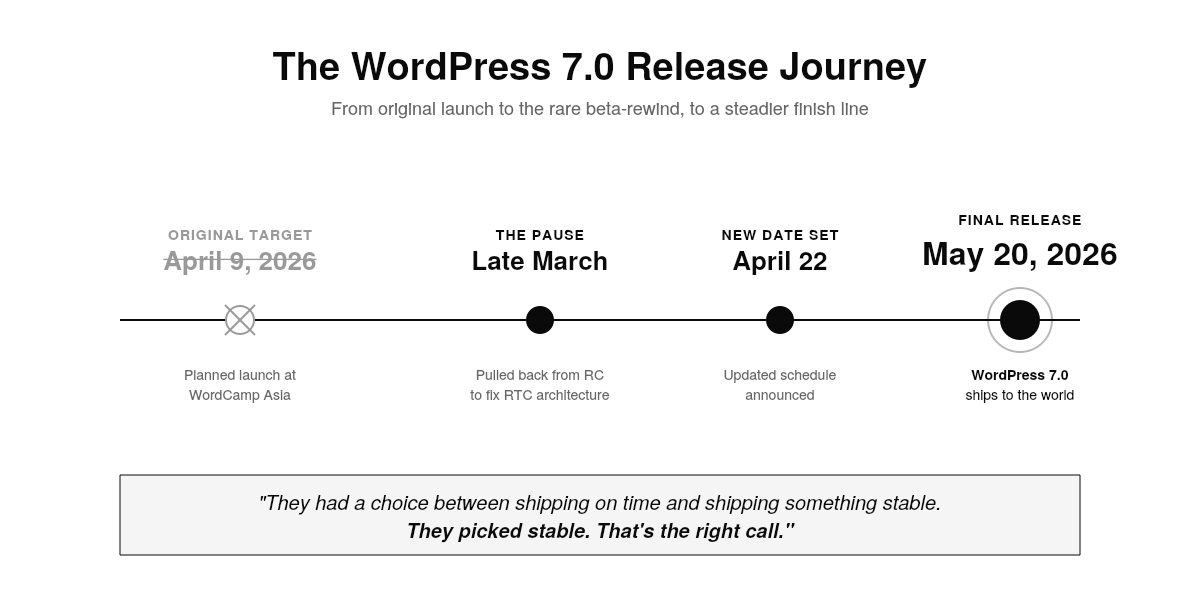
The new release date is May 20, 2026.
Update Impact Score: 4 / 5
Using the same framework I introduced in our December 2025 Google Core Update breakdown, here’s how I’d grade WordPress 7.0:
4 out of 5. Strong impact.
This isn’t a maintenance release. It’s the most significant WordPress release in years, and it changes the way teams build, edit, and manage sites. It’s not a 5 because most of what’s new is opt-in or under the hood, which means the average site won’t break overnight when it lands.
But the direction matters. WordPress 7.0 is the platform’s clearest move yet toward AI integration and team-based content workflows. If you’re not paying attention, you’re going to be playing catch-up by next year.
What’s Actually New in WordPress 7.0
Here’s the short list of what’s coming, with my take on what each one means for a business owner.
Real-Time Collaboration
Two people can now edit the same page or post at the same time, the way you would in Google Docs. This is the feature that delayed the entire release, and it’s the one that gets all the headlines. Useful for agency teams and larger marketing departments. Less of a daily-driver feature for a five-person business.
Built-In AI Connectors
WordPress 7.0 introduces a standardized way to connect your site to external AI providers like OpenAI, Google, and Anthropic. This is foundational, not flashy. You won’t see “Click here for AI” in your dashboard on day one. What you will see, over the next 12 to 18 months, is plugins and tools that plug into this layer to add real AI features to your site. This is WordPress laying pipe for the next decade.
Visual Revisions
When you edit content, you’ll now see color-coded overlays showing what changed. Green for additions, red for deletions, yellow for modifications. It’s a small thing. It’s also the kind of small thing that makes editing a site feel ten years newer.
New Icon Block
A native way to drop in icons from a curated library, without uploading SVGs or fighting with a plugin. Designers and content editors will appreciate this one.
Improved Mobile Navigation
Better controls and pre-built patterns for mobile menus. If your current site has a clunky mobile menu (it might), this is a meaningful upgrade.
Pattern Editing for Content Teams
Content editors can now edit text and images inside reusable patterns without accidentally breaking the layout. This is huge for clients who manage their own sites between our visits.
A Bigger Lift Under the Hood
Eight blocks got modernized text-alignment support. The custom CSS engine got more precise. Developers got new APIs. None of this is exciting if you’re not a developer. All of it adds up to a faster, cleaner platform.
Are We Updating Our Client Sites Right Away? No.
Here’s where I’m going to be honest with you in a way most agencies aren’t.
A major WordPress release is exciting. It is also a controlled risk. Plugins need time to be tested against the new version. Themes need time to be verified. Hosting environments need time to be confirmed compatible. The day a major version drops is not the day to push it to a live business website.
This is what we’ll be doing at J&R, in this order:
- Watch the release on May 20th. We’ll see what breaks for other people first. That’s not laziness. That’s how you protect a client’s business.
- Test on staging. Every site we manage has a staging environment. We’ll clone production sites, run 7.0 on the clones, and check every plugin, every form, every checkout flow.
- Verify plugin compatibility. Most major plugins (the kind we use for our clients) will issue their “Tested up to: 7.0” certification within a few weeks of release. We wait for that.
- Schedule the update. Once we’re confident, we update our managed sites in waves, not all at once.
If you’re on one of our managed website plans, this is already handled. You don’t need to do anything. We’ll let you know when your site has been updated and what’s new for you.
If you manage your own WordPress site, my advice is the same advice I’d give for any major release: don’t update on day one. Wait two to four weeks. Back up first. Test in staging if you can.
What This Says About WordPress
Twenty years in, WordPress is doing something most platforms its age don’t do: it’s still evolving in meaningful ways.
Squarespace and Wix have to add features carefully because everyone is on the same shared infrastructure. WordPress can move faster because the platform itself is just a foundation. Real-time collaboration, AI integration, modern editing, these are platform-level upgrades that ripple out to every site that runs on it.
This is also why we keep recommending WordPress over the alternatives, even when clients come to us excited about something simpler. The simpler platforms feel easier on day one. They feel limiting on day 365. WordPress feels intimidating on day one. By day 365, you don’t even think about it. It just works, it grows with you, and every couple of years, it gets meaningfully better.
May 20th will be one of those days.
The Bottom Line
You don’t need to do anything right now. WordPress 7.0 is coming. It’s going to make WordPress sites better, more collaborative, and more ready for the AI-shaped future of the web. The release was delayed because the team chose stability over a deadline, which is exactly what you want from the platform underneath your business.
If your site is on WordPress, you’re already in the right place.
If your site isn’t on WordPress, and you’ve been wondering whether it’s time to make the move, this release is one more reason to consider it. Let’s talk.
– Joe Russo